
Specifications
Surface Treatments
Certifications
- ISO 9001 - 2015 Certified
- PED 2014/68/EC
- NACE MR0175/ISO 15156-2
- NORSOK M-650
- DFAR
- MERKBLATT AD 2000 W2/W7/W10
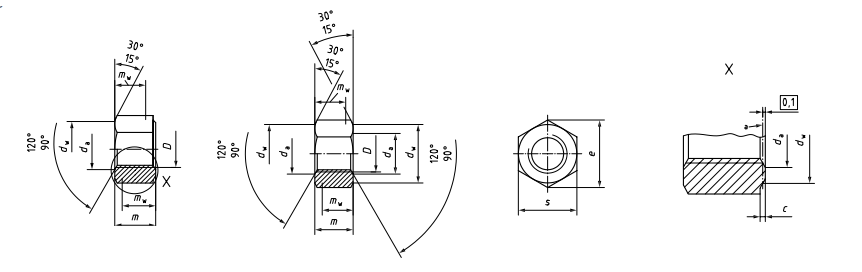
ISO 4033 Hexagon High Nut specifications
provide targeted dimensional
outlines for Style 2
components, explicitly engineered to accommodate immense proof loads in high-stress
assemblies.
While the ISO 4032 standard successfully establishes the baseline for general-purpose
metric fastening,
high-performance engineering assemblies utilizing extreme-tension property class 9, 10,
or 12 bolts demand a
mating nut with significantly augmented shear resistance.
This specialized requirement is the exclusive domain of the ISO 4033
standard, which strictly
outlines the dimensional characteristics of hexagon "high nuts" or "Style 2" nuts.
The defining geometric feature of a Style 2 nut is its height (m), which is
significantly and
purposefully greater than that of a standard Style 1 nut.
This vertical extension is not a byproduct of manufacturing; it provides vital
additional internal thread
engagement length.
By distributing the immense axial tensile load across a much larger internal shear
area, the ISO
4033 standard ensures that, in the catastrophic event of absolute joint
failure, the high-strength bolt
will stretch and break before the nut threads yield and strip.
In structural engineering, bolt fracture is a highly visible, predictable, and
manageable failure mode compared
to the sudden, hidden failure of stripped internal nut threads.
The ISO 4033 standard covers a nominal thread size range from M5 up to
M36.
Like its Style 1 counterpart, these high nuts are manufactured to exacting
Product Grade A tolerances
for internal threads D ≤ M16, and Product Grade B tolerances for threads D > M16,
establishing the necessary
geometric accuracy for precise bearing face runout and WAF uniformity.
The exacting limits on the minimum wrenching height (mw) and the minimum width across
corners (e) ensure that
powerful pneumatic tools and hydraulic torque multipliers can safely and continuously
engage the nut without
rounding the metal corners under maximum installation torque.
For mechanical designers and structural draftsmen, selecting an ISO 4033 high
nut is an active decision
to prioritize ultimate joint survivability over spatial envelope constraints.
| Nominal Size | c | da | e | s | m | Weight Per Pc (H=D) | ||||
|---|---|---|---|---|---|---|---|---|---|---|
| Max | Min | Max | Min | Min | Max | Min | Max | Min | ||
| M1.6 | 0.2 | 0.1 | 2.42 | 2 | 3.41 | 3.2 | 3.02 | - | - | - |
| M2 | 0.2 | 0.1 | 3.07 | 2.5 | 4.32 | 4 | 3.82 | - | - | - |
| M2.5 | 0.3 | 0.1 | 4.07 | 3.5 | 5.45 | 5 | 4.82 | - | - | - |
| M3 | 0.4 | 0.15 | 4.57 | 4 | 6.01 | 5.5 | 5.32 | - | - | - |
| M4 | 0.4 | 0.15 | 5.88 | 5 | 7.66 | 7 | 6.78 | - | - | - |
| M5 | 0.5 | 0.15 | 6.88 | 6 | 8.79 | 8 | 7.78 | 5.10 | 4.80 | - |
| M6 | 0.50 | 0.15 | 6.75 | 6.00 | 11.05 | 10.00 | 9.78 | 5.70 | 5.40 | 0.0028 |
| M8 | 0.60 | 0.15 | 8.75 | 8.00 | 14.38 | 13.00 | 12.73 | 7.50 | 7.14 | 0.0057 |
| M10 | 0.60 | 0.15 | 10.80 | 10.00 | 17.77 | 16.00 | 15.73 | 9.30 | 8.94 | 0.0126 |
| M12 | 0.60 | 0.15 | 13.00 | 12.00 | 20.03 | 18.00 | 17.73 | 12.00 | 11.57 | 0.0181 |
| M14 | 0.60 | 0.15 | 15.10 | 14.00 | 23.36 | 21.00 | 20.67 | 14.10 | 13.40 | 0.0300 |
| M16 | 0.80 | 0.20 | 17.30 | 16.00 | 26.75 | 24.00 | 23.67 | 16.40 | 15.70 | 0.0374 |
| M18 | 0.80 | 0.20 | 19.50 | 18.00 | 29.56 | 27.00 | 26.16 | 17.60 | 16.90 | 0.0522 |
| M20 | 0.80 | 0.20 | 21.60 | 20.00 | 32.95 | 30.00 | 29.16 | 20.30 | 19.00 | 0.0734 |
| M22 | 0.80 | 0.20 | 23.70 | 22.00 | 37.29 | 34.00 | 33.00 | 21.80 | 20.50 | 0.0880 |
| M24 | 0.80 | 0.20 | 25.90 | 24.00 | 39.55 | 36.00 | 35.00 | 23.90 | 22.60 | 0.1242 |
| M27 | 0.80 | 0.20 | 29.10 | 27.00 | 45.20 | 41.00 | 40.00 | 26.70 | 25.40 | 0.1770 |
| M30 | 0.80 | 0.20 | 32.40 | 30.00 | 50.85 | 46.00 | 45.00 | 28.60 | 27.30 | 0.2528 |
| M33 | 0.80 | 0.20 | 35.60 | 33.00 | 55.37 | 50.00 | 49.00 | 32.50 | 30.90 | 0.3280 |
| M36 | 0.80 | 0.20 | 38.90 | 36.00 | 60.79 | 55.00 | 53.80 | 34.70 | 33.10 | 0.4452 |
| M39 | 1.00 | 0.30 | 42.10 | 39.00 | 66.44 | 60.00 | 58.80 | 37.50 | 35.90 | 0.5885 |
| M42 | 1.00 | 0.30 | 45.40 | 42.00 | 71.30 | 65.00 | 63.10 | - | - | 0.7298 |
| M45 | 1.00 | 0.30 | 48.60 | 45.00 | 76.95 | 70.00 | 68.10 | - | - | 0.9410 |
| M48 | 1.00 | 0.30 | 51.80 | 48.00 | 82.60 | 75.00 | 73.10 | - | - | 1.1354 |
| M52 | 1.00 | 0.30 | 56.20 | 52.00 | 88.25 | 80.00 | 78.10 | - | - | 1.3930 |
| M56 | 1.00 | 0.30 | 60.50 | 56.00 | 93.56 | 85.00 | 82.80 | - | - | 1.6460 |
| M60 | 1.00 | 0.30 | 64.80 | 60.00 | 99.21 | 90.00 | 87.80 | - | - | 1.9688 |
| M64 | 1.00 | 0.30 | 69.10 | 64.00 | 104.86 | 95.00 | 92.80 | - | - | 2.2827 |
ISO 4033 hexagon high nuts (Style 2) are preferred for high-strength bolting where additional thread engagement is required. For Style 1 see ISO 4032; for thin (jam) nuts see ISO 4035. Common A194 grades for high-pressure metric service: Grade 2H, Grade 8M. Full specification: ASTM A194 PDF. A194 hub.
ISO 4033 is the international standard for metric hexagon high nuts (Style 2), with greater thickness than standard ISO 4032 nuts. Sizes M5 to M36. The increased thickness provides higher load capacity and thread engagement for high-strength applications.
ISO 4033 high nuts are preferred in high-strength bolting (8.8, 10.9, 12.9 property classes) where additional thread engagement is required. ISO 4032 standard nuts can develop the bolt's strength up to grade 8.8; above that, ISO 4033 is specified.
The thickness (m) of an M16 ISO 4033 hexagon high nut is 17.1 mm (versus 14.8 mm for ISO 4032). Width across flats (s) is 24 mm, identical to ISO 4032.